The Real Guide
No gimmicks, no shame, no outdated fruit metaphors. Just practical, honest advice on using fit, proportion, and styling to look and feel your best — whatever shape you are.
Why “Dressing for Your Body Type” Actually Matters
Fashion advice online is full of contradictions. One article tells you to hide your hips; another tells you to celebrate them. The truth is that dressing well has nothing to do with hiding or fixing your body — it’s about understanding proportion, fit, and the visual effects that clothing creates.
Every body has its own geometry. When you understand how fabrics, cuts, and silhouettes interact with your specific geometry, getting dressed becomes intentional rather than accidental. You stop buying things that look great on a hanger and terrible on you.
- It will give you practical, specific tips based on real styling principles — not vague platitudes.
- It will treat all body types as equally valid starting points, not problems to be solved.
- It won’t tell you what you “should” or “shouldn’t” wear — only what tends to work visually and why.
The Core Principles of Proportion Dressing
Before diving into specific body shapes, you need to understand the visual vocabulary. These principles apply regardless of your shape, size, or gender expression.
Principle 1 — Fit is everything
- Clothes that fit your actual body always look better than clothes that are too big or too small.
- “Fitting” means fabric lies flat, seams sit where they’re supposed to, and nothing pulls, gaps, or bunches.
- Tailoring even one or two key pieces (a blazer, a pair of trousers) can transform your entire wardrobe’s impact.
- Size tags are meaningless — sizing varies wildly across brands. Buy what fits, ignore the number.
Principle 2 — Visual balance and proportion
- The human eye is drawn to contrast and symmetry. Styling that creates visual balance reads as “put together.”
- If one part of an outfit is voluminous, pair it with something fitted elsewhere.
- Colour blocking can widen or narrow parts of the body — dark colours recede, bright/light colours advance.
- Horizontal lines draw the eye side to side (appearing to widen); vertical lines draw the eye up and down (appearing to elongate).
Principle 3 — The waist is your anchor point
- Defining the waist — or the point where top and bottom meet — creates proportion no matter the body type.
- You don’t need an hourglass figure to “show a waist.” Even a slight tuck, a belt, or a fitted mid-section creates visual structure.
- High-waisted bottoms elongate the legs and create structure in the torso for almost every body type.
Pear / Triangle Body Type
This is one of the most common body shapes, especially in women. The hips and thighs carry more volume than the shoulders and bust. The goal isn’t to “minimise” the hips — it’s to create visual balance by building presence in the upper body.
- Boat necks, square necks, and wide necklines add visual width to the shoulder area.
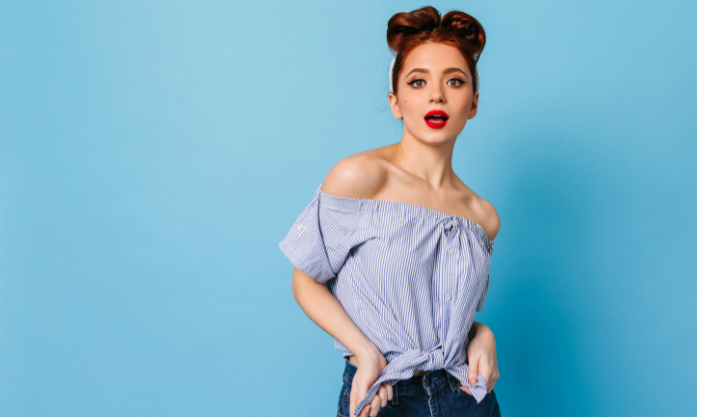
- Off-shoulder tops, puff sleeves, structured shoulders, and statement sleeves all broaden the upper frame.
- Bold prints, bright colours, and horizontal stripes are best worn on top to draw the eye upward.
- Layering jackets (especially cropped blazers or structured moto jackets) adds volume to shoulders.
- A-line skirts and flared trousers skim over the hips without clinging — they flow gracefully.
- Dark, solid colours on the bottom create a streamlined effect.
- High-waisted bottoms elongate the legs and define the waist.
- Straight-leg or wide-leg jeans balance the hip-to-shoulder ratio better than skinny jeans.
- Tapered ankle trousers that make hips appear wider by contrast.
- Low-rise jeans that emphasise the hips without any waist definition.
Hourglass Body Type
The hourglass shape has roughly equal shoulder and hip width with a noticeably narrower waist. The main challenge isn’t creating balance — it’s avoiding styles that obscure the natural proportion you already have.
- Wrap dresses and tops are purpose-built for this silhouette — they follow the waist-to-hip curve naturally.
- Fit-and-flare silhouettes (fitted bodice, flared skirt) honour both the defined waist and fuller hips.
- Belted outfits — even a simple belt on a dress or blazer — reinforce the waist definition.
- Bodycon styles work well if that’s the aesthetic you want, as the body already has natural structure.
- Tailored trousers with a fitted blouse tucked in is a classic combination for this shape.
- Oversized, boxy clothing in stiff fabrics can make this shape look larger than it is by hiding structure.
- Wearing a top that’s too tight across the bust while the waist swims in fabric — everything should fit the largest point and be tailored from there.
Rectangular / Straight Body Type
This shape has shoulders, waist, and hips in close alignment, with little natural curve definition. The goal for many with this shape is to create the appearance of curves and structure — though you’re equally free to lean into clean, geometric silhouettes that this shape wears exceptionally well.
- Peplum tops and dresses add a flare at the hip that suggests a waist-to-hip curve.
- Ruched, gathered, or draped fabric at the midsection creates visual dimension.
- High-waisted anything — jeans, skirts, trousers — defines the waist against the hip.
- Two-tone outfits (dark top, light bottom or vice versa) create contrast that implies proportion.
- Belts worn at the waist on dresses or oversized shirts are transformative for this shape.
- Tailored, minimalist cuts — think straight-leg trousers, clean shift dresses, structured blazers — sit beautifully on a straight silhouette.
- Bold patterns, colour blocking, and interesting textures read clearly without competing with strong curves.
- Layering works exceptionally well — straight shapes carry layers cleanly without adding bulk.
- Wide-leg trousers with a cropped top create an intentional, fashion-forward proportion.
Inverted Triangle Body Type
This shape — common in athletic builds and many men — features wide, strong shoulders with a narrower hip and waist. The visual challenge is to create width in the lower half to bring the figure into balance, or to lean fully into the angular, powerful look.
- Wide-leg and flared trousers, A-line and pleated skirts add volume at the hip and thigh.
- Light or bright colours on the bottom, darker tones on top, to visually build the lower half.
- Prints on the lower half draw the eye downward and create the appearance of width.
- High-waisted bottoms that gather or pleat at the waist add hip curve.
- Bootcut jeans are especially flattering — the flare at the ankle mirrors the shoulder width.
- V-necks and deep scoop necks elongate the neck and draw the eye inward and downward, softening broad shoulders.
- Avoid boat necks, off-shoulder, and cap sleeves — they exaggerate shoulder width.
- Avoid heavy layering, big lapels, and structural epaulettes on top — save the volume for below the waist.
- Fitted tops in dark or solid colours streamline the upper body without adding bulk.
Apple / Round / Oval Body Type
This shape carries weight primarily in the midsection — the stomach, chest, and upper back. The arms and legs are often proportionally slimmer. The goal is to create vertical flow through the torso and draw attention to the parts you love — great legs, a defined décolletage, toned arms.
- V-necks and wrap tops create a long vertical line through the chest, elongating the torso visually.
- Empire-waist styles define at the narrowest point just under the bust, bypassing the midsection entirely.
- Dark, solid colours in the midsection with interest (print, colour) at the neckline or hem redirect the eye.
- A-line and fit-and-flare dresses skim the midsection without clinging, falling beautifully from the narrowest point available.
- Monochromatic outfits (one colour head to toe) create a continuous vertical line that is enormously elongating.
- Statement shoes and jewellery pull attention up or down, away from the midsection.
- Medium-weight fabrics with some drape (jersey, ponte, crepe) skim without clinging.
- Avoid stiff, thick fabrics like heavy denim or canvas around the midsection — they add volume.
- Avoid very thin, clingy fabrics (satin, tissue-weight jersey) that show every contour.
- Structured blazers are magic — they create a long vertical line, define a shoulder, and skim the stomach.
Universal Rules That Work for Every Body
These principles transcend body type. They’re the things stylists apply to literally every client regardless of shape or size.
- Going a size up hoping to “hide” something typically makes you look larger overall.
- Going a size down hoping to look smaller creates pulling, gaping, and discomfort that reads immediately.
- Clothes cut for your actual body always look cleaner and more intentional than anything else.
- A well-fitting bra changes how everything on top looks — it’s the single most transformative undergarment.
- Seamless underwear eliminates visible lines under fitted clothing.
- Shapewear is a personal choice — never a requirement — but if you use it, ensure it’s comfortable enough to wear for the full duration.
- Trousers should graze the top of the shoe without bunching (or, for a fashion-forward look, cropped clean above the ankle).
- Midi skirts that fall at the widest part of the calf can cut the leg and shorten the figure — try just below or above the widest point instead.
- Mini lengths show leg and are universally elongating — the question is only personal comfort.
- The hem of a top draws the eye to whatever body part it ends at — think about whether that’s where you want attention.
- A top that ends at the hip widens it visually; one that ends at the waist defines it.
- Cropped jackets end at a different point than full-length ones — test each in a mirror before buying.
- Nude or skin-tone shoes extend the line of the leg for all body types and heel heights.
- Ankle straps shorten the leg by creating a visual break — choose them intentionally.
- Pointed toes elongate; square or round toes are more casual and compact in appearance.
- Clothes that feel good to wear read better than technically “correct” clothes that make you uncomfortable.
- The way you carry yourself — posture, pace, ease — affects how an outfit lands more than any styling trick.
- Rules exist to be understood and then broken intentionally. Fashion has no actual laws.
Also Read:-
Female founders: Bootstrap vs VC funding guide today tips!!!
Top Must-Read Books for Every Ambitious Woman Today
Women Who Left Corporate